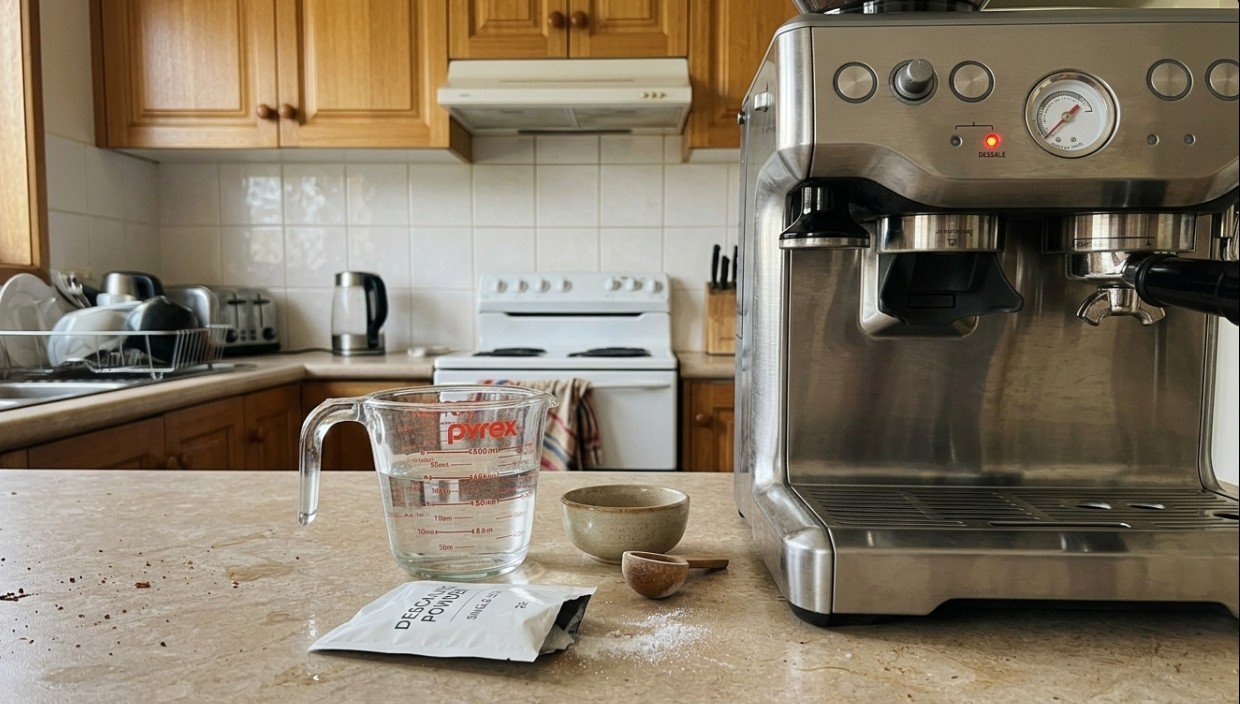
Key takeaway: Descale your Breville once the CLEAN/DESCALE light turns solid rather than flashing (a flashing light means a separate cleaning cycle for coffee oils, not scale), using Breville’s own descaling powder instead of vinegar. Run it through the coffee, steam and hot water components, then flush with plain water, and expect to repeat the whole job roughly every two to three months, sooner in hard water areas.
To descale a Breville coffee machine, dissolve Breville’s own descaling powder into water, run it through the machine’s coffee, steam and hot water components using your model’s descale mode, then flush the tank with plain water afterwards. The exact button sequence differs across the range, a Barista Express isn’t triggered the same way as a Bambino Plus, but the underlying process, and the mistakes that ruin it, are identical no matter which Breville sits on your bench.
Check Which Light Is Actually On First
Most Breville machines use the same CLEAN/DESCALE light for two different jobs, and mixing them up is the most common reason people think they’ve descaled when they’ve only run a cleaning cycle. A flashing light usually calls for the cleaning cycle, which uses a cleaning tablet to clear coffee oils from the group head. A light that’s solidly on, not flashing, means mineral scale has built up and it’s time to descale instead.
Some models flag it differently again. On the Bambino Plus, Breville’s own support page states the 1-Cup, 2-Cup and Steam buttons all flash together in alternation when descaling is due, rather than a single dedicated light. If you’re not certain what your machine is asking for, check its instruction book before you start. Running a cleaning tablet through a machine that actually needs descaling won’t touch the scale causing the problem.
What You’ll Need
- Breville descaling powder, or the descaling solution specified for your model
- Fresh, cold tap water
- A jug or container to catch overflow around each component
- Your machine’s instruction manual, since button sequences differ by model
How to Descale a Breville Coffee Machine
- Remove the water filter cartridge first, if your model has one. Breville’s manuals are explicit that the filter needs to come out before you add descaling powder, since the powder isn’t meant to pass through it.
- Dissolve the descaling powder in water at the ratio your manual states. On a Barista Express, that’s one sachet dissolved into one litre of water, then poured into the tank.
- Enter descale mode using your model’s button combination. Check your manual if you’re not on a Barista Express, since the sequence genuinely changes across the range (see the worked example below).
- Run the solution through the coffee, steam and hot water components in turn, following whatever prompt or light sequence your model uses. Each component only takes seconds, not minutes.
- Repeat the cycle until the tank of solution is used up. Most Breville machines are designed to use the batch across a few repeated passes rather than one long run.
- Remove the tank, rinse it out properly, then refill with fresh cold water and run the same cycle again with plain water to flush any leftover solution out before you make coffee.
- Exit descale mode, usually by pressing the power button, once the tank is empty and the rinse cycle is done.
Worked Example: Descaling a Breville Barista Express
The Barista Express (BES875) is one of Breville’s best-selling home machines, and its instruction book spells out the process in full, so it’s worth walking through as a concrete example even if you own a different model. Dissolve one Breville descaling sachet into one litre of water and fill the tank. Press and hold the 2-Cup button, then press and hold Power, to enter descale mode. The machine is ready once the Power button, the 1-Cup button, the CLEAN/DESCALE light and the hot water/steam light are all lit solidly rather than flashing. Press 1-Cup to descale the coffee component, which takes about 25 seconds, then turn the steam dial to descale the steam and hot water sides in turn, around 13 and 8 seconds respectively. One pass through leaves roughly half a litre of solution in the tank, so repeat the coffee, steam and hot water steps until it’s gone. Pull the tank out, rinse it, refill to the 2 litre max line with fresh water, and run the same three components again to clear out any trace of descaling solution. Press Power to finish. If you get interrupted partway through, the machine exits descale mode automatically after 5 minutes of inactivity, so you’ll need to start again from the button combination step.
How Often to Descale a Breville
Breville’s general guidance is roughly every two to three months under typical home use, though water hardness matters more than the calendar. The harder your tap water, the faster minerals build up inside the machine. It’s also why Breville sells a water filter cartridge for the tank and recommends replacing it every two months: a fresh filter measurably slows how quickly scale forms in the first place. If you’re filling the tank straight from hard tap water with no filter fitted, don’t be surprised if the solid CLEAN/DESCALE light shows up well before the three-month mark.
Common Mistakes
- Reaching for vinegar instead of a proper descaling solution. Breville specifically warns against it, since vinegar can leave a residue, affect the taste of your coffee and damage seals or metal parts over time.
- Leaving the water filter cartridge in the tank during descaling. It needs to come out first.
- Confusing a flashing light (cleaning cycle) with a solid one (descaling) and running the wrong process entirely.
- Skipping the final rinse with plain water, which leaves descaling solution residue sitting in the system.
- Assuming every Breville uses the same button sequence. It doesn’t, so check your own model before you start rather than copying a video made for a different machine.
When to Call It
If the CLEAN/DESCALE light stays on after a full descale, or the machine’s flow and pressure don’t recover afterwards, mineral deposits may already be affecting internal components beyond what a home descale reaches. At that point, repeating the cycle over and over won’t help. Breville’s own troubleshooting guide points to an authorised service centre instead, since some blockages need to be cleared mechanically rather than dissolved.
We’ve covered the coffee-oil side of maintenance separately in how to clean a Breville coffee machine, and we’ll add a dedicated how-to-use guide and a broader coffee machine buying guide as this site builds out.
Frequently Asked Questions
Can I use vinegar to descale a Breville coffee machine?
No. Breville specifically advises against it, since vinegar can leave a residue that affects flavour and can damage the machine’s seals and metal parts over time. Use a proper descaling solution instead.
How do I know if my Breville needs descaling or cleaning?
Check whether the CLEAN/DESCALE light is flashing or solid. A flashing light generally means the cleaning cycle is due, using a cleaning tablet, while a solid light means it’s time to descale. Some models signal it differently again, so check your own manual if you’re not sure.
How often should I descale my Breville coffee machine?
Roughly every two to three months under typical use, though hard water areas need it sooner. Replacing the tank’s water filter cartridge every two months, as Breville recommends, slows down how quickly scale builds up in the first place.
What’s the button sequence to enter descale mode on a Breville?
It depends on the model. A Barista Express is put into descale mode by holding the 2-Cup and Power buttons together, while other machines in the range use a different combination. Check your own instruction manual rather than assuming every Breville matches.
How much water does a Breville Barista Express’s tank hold?
The Barista Express has a removable 2 litre water tank, filled from the top, which is roughly how much fresh water you’ll want on hand for the final rinse cycle after descaling.
