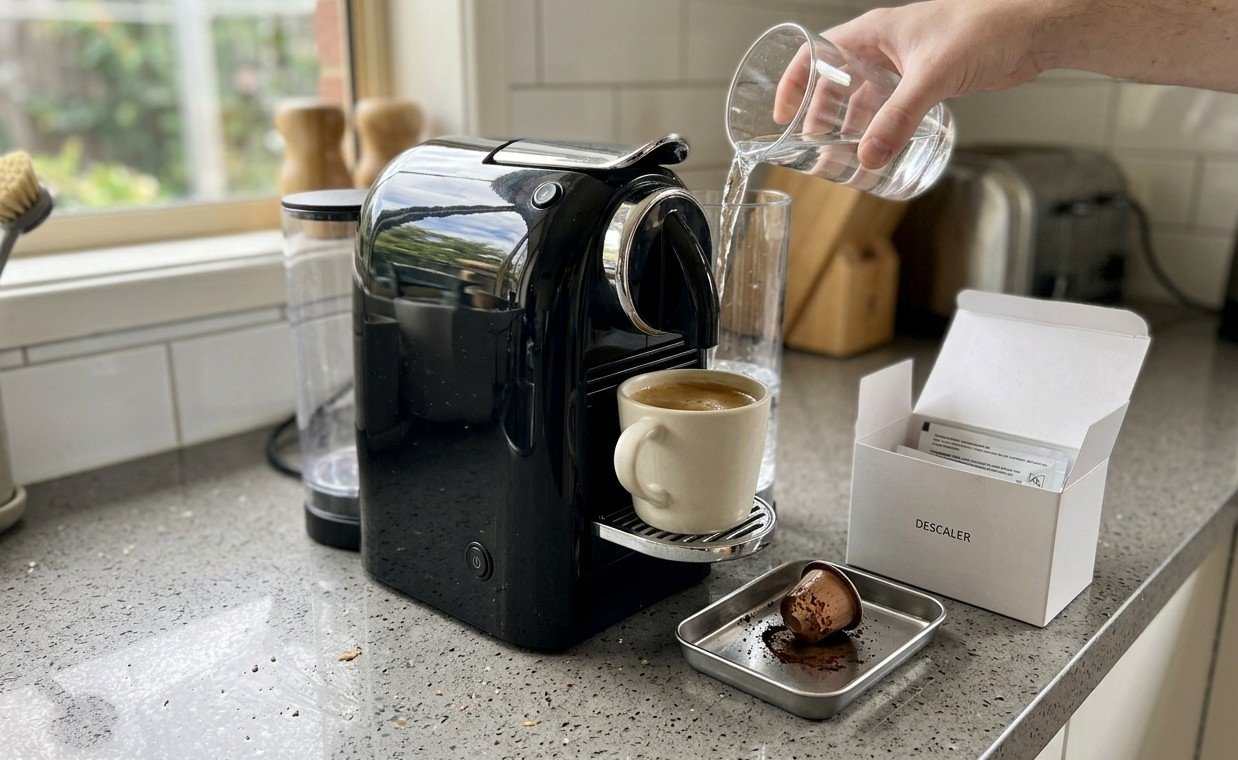
Key takeaway: Descaling removes mineral buildup (limescale) from a coffee machine’s internal water pathways using a mild acid, ideally a dedicated descaler or plain citric acid rather than vinegar, run through the machine and followed by two or three rinse cycles with fresh water. How often depends on your local water hardness and how much you use the machine, but every one to three months is a reasonable general guide if your machine doesn’t tell you itself.
To descale a coffee or espresso machine, dissolve a dedicated descaler (or citric acid) in water, run it through the machine the way you’d run a normal brew but without any coffee or pod in place, then flush the system with two or three cycles of plain water afterward. This generic process is aimed at machines too small a brand to have their own dedicated guide; if you own a Breville, DeLonghi or Nespresso machine, their own built-in process is faster and more precise than this one.
What Is Descaling and What Does It Actually Do?
Descaling is the process of dissolving mineral deposits, mainly calcium and magnesium from your tap water, that build up inside a machine’s heating element, boiler and internal tubing over time. Left alone, that scale narrows the pathways water flows through, makes the heating element work harder to reach the same temperature, and eventually affects both how fast your machine brews and how the coffee actually tastes. It’s a maintenance job, not a deep clean: it targets mineral buildup specifically, rather than the coffee oils and residue that ordinary cleaning deals with.
What Can You Use to Descale a Coffee Machine?
- A dedicated descaling solution, sold for coffee machines specifically. This is the safest default and what most manufacturers recommend.
- Plain citric acid powder, roughly two tablespoons dissolved per litre of water, as a cheaper DIY alternative that works on the same chemical principle as most commercial descalers.
- Vinegar, as a last resort only. It can dissolve scale, but it’s a weaker acid than citric acid, tends to need repeating, and leaves a smell and taste that lingers longer than a proper descaler.
It’s worth being direct about vinegar, since it’s the default a lot of people reach for. Every major manufacturer we’ve checked for this site so far, Breville, DeLonghi and Nespresso among them, explicitly tells owners not to use it, warning that an unsuitable descaler can affect flavour, damage seals or void warranty cover. That’s not one brand being cautious, it’s a consistent pattern across several unrelated manufacturers, which is a good reason to treat it as more than marketing caution.
How to Descale a Coffee Machine (General Steps)
- Check whether your machine has its own built-in descale mode first. If it’s a brand with a dedicated guide on this site, use that process instead, it’ll be faster and more precise than the generic version below.
- Empty and rinse the water tank, and remove any water filter cartridge if your model has one.
- Mix your descaler or citric acid with water according to the instructions on the pack, or the two-tablespoons-per-litre ratio for plain citric acid.
- Run the solution through the machine as if brewing, with no coffee, pod or filter in place, into a container rather than a cup.
- Let it sit briefly if your machine’s instructions call for it. Some machines want the solution to sit in the system for several minutes partway through rather than running straight through.
- Run two to three full cycles of plain water afterward to flush out any leftover solution before you make coffee again.
- Wipe down the exterior and empty the drip tray once you’re done.
How Often to Descale
There’s no single correct number of months that applies to every machine, since it comes down to how hard your local water is and how often you use it. As a general guide, expect somewhere between one and three months in a harder water area, stretching toward three to six months if your water is soft. If your machine has its own descale light or on-screen prompt, trust that over a fixed calendar date.
Common Mistakes
- Reaching for vinegar as the default, rather than a dedicated descaler or citric acid, when every major manufacturer we’ve checked specifically advises against it.
- Skipping the rinse cycles afterward, which leaves acidic residue in the system and affects the taste of your next few coffees.
- Guessing at a fixed schedule instead of watching your machine’s own descale light or indicator, where it has one.
- Assuming this generic process matches your specific machine’s built-in program exactly. If your brand has its own guide, its process will be more precise than this one.
If your machine is a Breville, DeLonghi or Nespresso, use the dedicated guide for that brand instead of this generic process, it’ll match your machine’s actual button sequence and timing. We’ll add more brand-specific guides, including Smeg, as this site builds out.
Frequently Asked Questions
What does descaling a coffee machine actually do?
It dissolves mineral deposits, mainly calcium and magnesium from tap water, that build up inside the heating element and internal tubing over time. Left unchecked, that buildup narrows water pathways and reduces how efficiently the machine heats water.
What can I use to descale my coffee machine if I don’t have a proper descaler?
Plain citric acid powder, dissolved at roughly two tablespoons per litre of water, works on the same principle as most commercial descalers and is a reasonable DIY alternative. Vinegar will also dissolve scale but is weaker, slower and leaves a lingering smell and taste.
Is vinegar bad for descaling coffee machines?
Most manufacturers explicitly advise against it. Breville, DeLonghi and Nespresso all warn that an unsuitable descaler, vinegar included, can affect flavour, damage seals or void warranty cover.
How often should I descale my coffee machine?
It depends on your local water hardness and how often you use it, but one to three months is a reasonable general guide in a harder water area, stretching to three to six months with soft water. Trust your machine’s own descale light over a fixed schedule if it has one.
My coffee machine isn’t a big brand, does this generic process still apply to it?
Yes, the underlying process, dissolving mineral scale with a mild acid and rinsing it out, is the same across almost every machine. Check your manual for the exact dilution ratio and any specific instructions, but the general steps above will get you there.
