
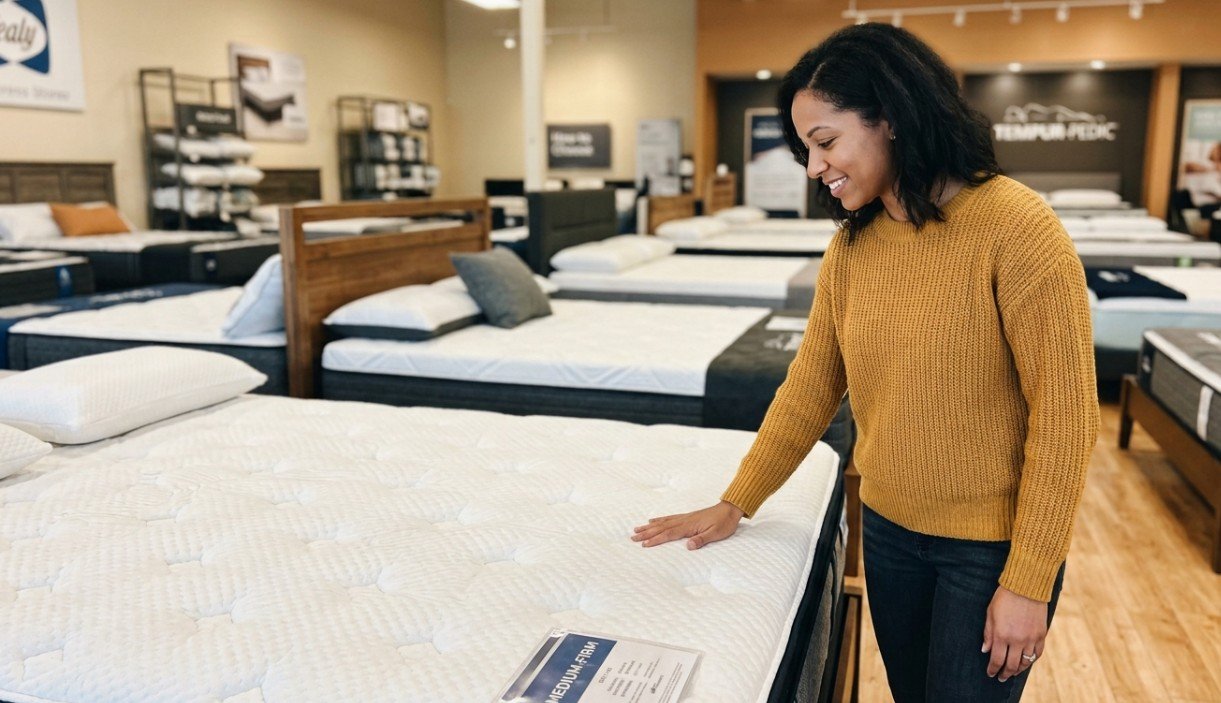
Match the mattress to how you sleep, then check the type, the size and the trial terms. Side sleepers tend to suit a softer surface, back sleepers a medium one and stomach sleepers a firmer one. There is no common firmness scale, so test it in person or buy with a clear trial period.
Learning how to choose a mattress comes down to four decisions: your sleeping position, the type of construction, the size, and the terms you buy under. Showrooms often push the decision the other way round, starting with the brand name and the sale tag. This guide works through the questions in the order that narrows the field fastest, so you can walk into a shop, or open an online checkout, already knowing what you need. It sits in our Mattress Guides.
Start with how you sleep
Sleeping position sets the firmness range to test first. CHOICE ties firmness to position rather than to a standard scale, which is a sensible starting point and nothing more.
| Position | Firmness to test first | Usual reason |
|---|---|---|
| Side | Softer | The shoulder and hip can sink in, which keeps the spine closer to level. |
| Back | Medium | Supports the lower back without pushing it up out of line. |
| Stomach | Firmer | Stops the hips sinking below the shoulders. |
Combination sleepers and couples often settle on medium as the easiest compromise. Body weight changes how a surface feels, so the same mattress can feel soft to one person and firm to another. That is also why a brand’s “medium” will not match another brand’s.
A mattress is one factor among many in back pain. A 2021 review of 39 studies found medium-firm mattresses tended to do better for non-specific low back pain, but the studies differed a lot in design and in how back pain was defined. If pain keeps coming back, see a GP or physiotherapist.
How to choose a mattress type: foam, spring, latex or hybrid
Most mattresses sold in Australia fall into four types: foam, innerspring, latex and hybrid. A hybrid mattress combines a spring base, usually pocket springs, with foam or latex comfort layers on top.
| Type | How it feels | Suits | Watch for |
|---|---|---|---|
| Foam | Moulds to the body with little bounce | Pressure relief, side sleepers | Can trap heat and feel “encased” |
| Innerspring | Bouncier, with more push-back | Airflow and a wide range of firmness | Can wear faster and pass on a partner’s movement |
| Latex | Springy but solid, and breathable | Durability, a cooler surface | Heavy to move and can feel solid underneath |
| Hybrid | Springs plus cushioning layers | A mix of support and comfort | Builds vary, so read the layer list |
Pocket springs sit in their own fabric sleeves and move independently, which is why they are the usual spring choice in hybrids and for couples. Labels such as “cooling” or “orthopaedic” vary between brands, so ask for the layer list and the material names rather than relying on the name.
Check the size and the space
Size decides how much room each person gets and whether the mattress suits the bedroom and the base. Measure the room and any base you already own, and leave space to walk around the bed. Dimensions can differ slightly between makers, so check the exact measurements on the product page before you order.
Test it properly, or buy with a trial
In a shop, spend more than a couple of minutes on each mattress. Move through your usual positions, bring your partner, and watch for movement when one of you turns over. Online and boxed-mattress brands usually replace the showroom with a trial period, commonly between 30 and 120 days, while traditional retailers rarely offer a comfort guarantee.
Read the trial terms before you pay. Check whether there is a return fee, whether the mattress has to stay clean and unmarked, and who arranges and pays for the pick-up.
Know your rights on trials, warranties and faults
A trial period is a seller’s own policy, not a legal right. The ACCC says a business does not have to refund a customer who simply changes their mind unless its own policy says so.
Faults are treated differently. A mattress that is faulty, does not match its description or is not of acceptable quality is covered by consumer guarantees, and a business cannot take those rights away with a “no refunds” sign. A manufacturer’s warranty is a separate promise with its own exclusions, so keep the receipt and photograph any defect.
Set a budget band, not a bargain target
Price is a weak guide to comfort. CHOICE’s testing found a mattress at the lower end of the market can feel as comfortable as one costing several times more. Decide your ceiling first, then compare what each option offers inside it, rather than chasing the biggest markdown.
| Band | What tends to change | What to check |
|---|---|---|
| Entry | Simpler builds with fewer comfort layers | That it suits your weight and position, and the return terms |
| Mid-range | More layers, and pocket springs or better foams are common | The full layer list and the warranty exclusions |
| Premium | Natural materials, zoned support and bigger sizes are common | Whether the extras matter to you, and the trial length |
These bands describe what is common, not what is guaranteed, so read each product’s specification sheet. Once the mattress is sorted, the next decision is what goes on it, which our Toppers & Protectors guides cover. How we check sources is explained on our about page.
Once you know the features to look for, what makes a good mattress explains how independent testers judge one.
Frequently asked questions
What type of mattress is best?
There is no single best type, because it depends on your sleeping position, body weight, temperature and whether you share the bed. Foam suits pressure relief, innerspring suits airflow, latex suits durability and a hybrid mixes support with cushioning.
How to choose a mattress if you sleep on your side?
A softer surface usually suits side sleepers, because it lets the shoulder and hip sink in. A soft foam or a soft hybrid are the common choices, and a trial period lets you confirm it over a few weeks.
How firm should a mattress be?
Start from your sleeping position: softer for side sleepers, medium for back sleepers and firmer for stomach sleepers. Firmness has no common scale, so one brand’s medium can feel different from another’s.
Is a more expensive mattress better?
Not necessarily. CHOICE’s testing found a mattress at the lower end of the market can feel as comfortable as one costing several times more, so compare materials, trial terms and warranty exclusions instead.
Can I return a mattress if I change my mind?
Only if the seller’s own policy allows it. The ACCC says businesses do not have to refund a change of mind unless their policy says so, which is why a clear trial period matters. Faulty mattresses are covered separately by consumer guarantees.