
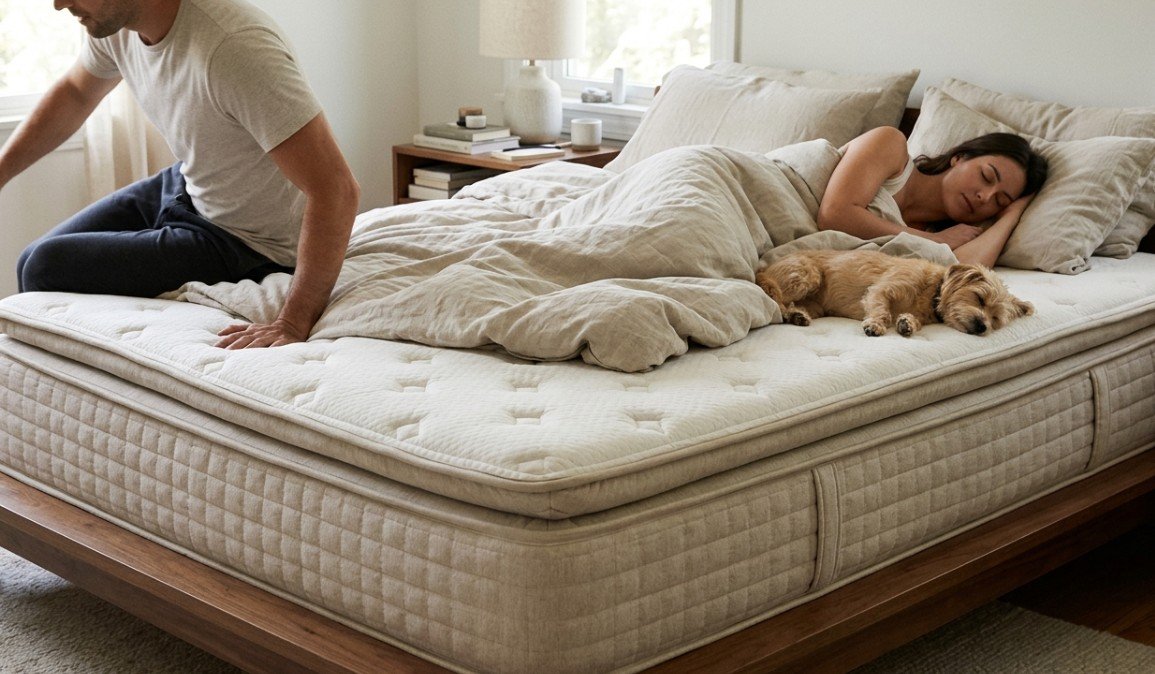
A mattress where you don’t feel your partner move is one with good stability, and pocket springs are the best place to start. In CHOICE’s lab tests, over half of the spring mattresses scored 60 per cent or higher for stability, against less than a third of the foam ones, even though foam is often marketed as the still option. Hybrids and pocket spring models tend to isolate movement, and linked coils carry it further. Ask for the construction and test the mattress with your partner moving beside you.
Motion transfer is the reason many couples change mattresses. This guide covers which constructions isolate movement best, how to test for it and what else affects it. It sits in our Mattress Guides.
The results below come from CHOICE’s lab tests of many models, plus how makers describe each construction. A single mattress can beat its type or fall short of it, so treat these as a guide to where to look, not a guarantee.
Mattress that doesn’t move when partner moves: what to look for
| Construction | Motion transfer | Why |
|---|---|---|
| Pocket spring | Lower | Each coil moves on its own, and CHOICE finds they tend to score well |
| Memory foam | Varies by model | Marketed as still, but fewer foam models score well in CHOICE’s stability test |
| Hybrid | Lower, varies | Pocket springs plus foam layers |
| Latex | Moderate | Buoyant and responsive |
| Linked coil | Higher | Coils are joined |
Our guides explain each type in turn: the pocket spring mattress, memory foam and the hybrid.
What CHOICE’s tests found
CHOICE tests movement by dropping a 17.5kg weight on the mattress, which simulates a sleeper turning, and counting how many bounces occur before it settles. Fewer bounces mean a higher score and less disturbed sleep.
In its foam versus spring article, over half of the spring mattresses scored 60 per cent or higher for stability, and less than a third of foam mattresses did. Some foam models score well, so check the individual mattress. Bonnell or light spring designs can feel bouncier and less stable.
How to test for motion transfer
- Bring your partner. Ask them to lie at one side while you lie at the other.
- Have them roll over and sit up. Notice how much you feel at your end.
- Try the edge. Sit down on the edge and see how the other side responds.
- Repeat for each firmness. The softer and thicker the comfort layers, the more movement they tend to absorb.
- Use the trial period. A shop test is short, so a home trial gives the real answer.
Memory foam means you will never feel your partner move.
Foam reduces movement but doesn’t remove it, and CHOICE’s stability test found fewer foam mattresses scoring well than spring ones. A thin memory layer over a stiff base does little. The whole build counts, including the base under the mattress.
Other things that change motion
The base matters. A sturdy, solid base or well-fitted slats keep the mattress stable, while a flexible base can add wobble. A topper can soften movement a little, but it won’t fix a mattress that carries motion strongly.
Size helps too. CHOICE suggests buying the largest bed your room can hold. A bigger bed puts more distance between sleepers, so a queen or king carries less movement than a double. Our guide on whether two adults can sleep on a double covers the space question, and the mattress size guide lists the common widths in centimetres.
What to weigh against it
The most motion-absorbing mattress can be warmer or less bouncy, which affects some people. If you and your partner differ a lot in weight, the heavier sleeper sinks further and the lighter one can roll toward the middle, so check how the mattress holds its centre. Weigh motion against heat and feel, and see memory foam vs spring mattress for the trade-offs. Our about page explains how we check sources.
Frequently asked questions
What mattress doesn’t move when your partner moves?
In CHOICE’s tests, pocket spring mattresses tend to have good stability, and over half of spring mattresses scored 60 per cent or higher. Hybrids can also do well. Results vary by model, so test the actual mattress with your partner.
Is memory foam or pocket spring better for motion transfer?
CHOICE found over half of spring mattresses scored 60 per cent or higher for stability, against less than a third of foam ones. Foam is often marketed as the more still option, but the testing says pocket spring is the safer starting point. Some foam models still score well.
Does a bigger bed reduce motion transfer?
Yes, it can. CHOICE suggests buying the largest bed your room can hold. More width puts sleepers further apart, so a queen or king carries less movement than a double.
Does a mattress topper reduce motion transfer?
A little, if it is a soft, thick foam topper. It won’t fix a mattress that carries a lot of motion.
How does CHOICE test mattress movement?
It measures the mattress’s movement after a 17.5kg impact that simulates a person turning, and counts how many bounces occur before it stops.
How can I test motion transfer in a shop?
Lie on it while your partner rolls and sits at the other side, then swap sides. A longer home trial gives the best answer.