
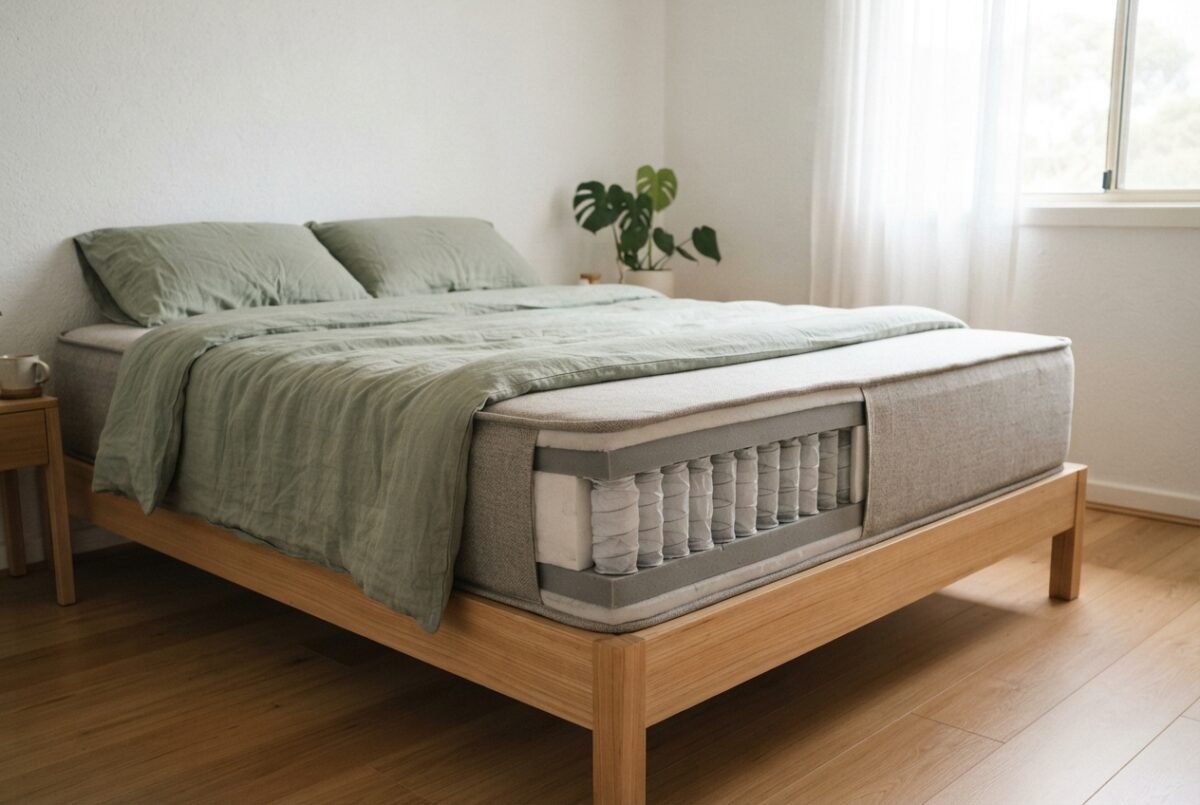
What is a hybrid mattress? It is a mattress that combines a spring core with foam or latex comfort layers on top. No Australian standard defines the word, so makers apply it loosely. Check the layer list rather than the label, because it tells you what the mattress is actually made of.
Hybrid is one of the most common words on a mattress tag and one of the least precise. This guide explains how a hybrid is built, how it differs from other types and what to check before you buy. It sits in our Mattress Guides.
The points below describe hybrids in general. Independent Australian testing groups mattresses by type, not by individual hybrid design, so any single model can differ.
What is a hybrid mattress?
A hybrid mattress combines a spring core, usually pocket springs, with foam or latex comfort layers above it. The springs carry most of the support and the upper layers shape how the surface feels.
CHOICE calls hybrid a loosely defined category and says there is no real standard behind the word. It uses the label only where the foam and the springs give roughly equal support, not where foam is just a topper over a spring core. Plenty of mattresses wear the label without meeting that test.
How a hybrid mattress is built
| Layer | Usual job | Ask the seller |
|---|---|---|
| Cover | Fabric surface, often quilted | What it is made from |
| Comfort layers | Foam or latex for feel | Which material, in what order |
| Support core | Springs, often pocket springs | Which spring type |
| Base layer | Foam or fabric under the springs | How it affects the base you use |
Pocket springs are the type CHOICE meets most often in testing. Each spring is wrapped on its own, so they act independently. Older Bonnell coils are linked together, and CHOICE found these models can feel bouncier and pass movement to a partner. Our guide to pocket spring mattresses covers that core in more depth.
Spring mattresses are never springs alone. CHOICE says the core is surrounded by foam layers for support and comfort, which is why a plain spring mattress and a hybrid can look alike on paper.
Hybrid compared with other mattress types
| Type | Core | What CHOICE found |
|---|---|---|
| Innerspring | Linked coils | Can feel bouncier, movement can transfer |
| Pocket spring | Wrapped springs | Good stability, steady comfort over time |
| Foam | Foam throughout | Less sag, can feel warmer |
| Hybrid | Springs plus foam | Shares the pros and cons of both |
More springs always means a better mattress.
CHOICE found no link between a higher spring count and better performance. Build quality and the layers above the springs matter far more than the number on the tag.
Strengths and limits of a hybrid
Airflow is the clearest difference CHOICE measured, though not for hybrids specifically. More spring models than foam models had a cool feel, and spring models also repelled sweat better. Sweat can wear down foam over time, so a spring-based build suits people who run hot.
On support, type alone doesn’t decide it. CHOICE saw a spread of good, average and poor results across both foam and spring models. Over half of the spring models scored well on stability, against fewer than a third of the foam models.
What we couldn’t find is independent evidence on hybrid motion isolation, edge support or lifespan. Makers make these claims, but we haven’t been able to check them against a government, university or CHOICE source. Our guide to how long a mattress lasts sets out the ranges we can source.
Who a hybrid mattress suits
Firmness matters more than the type. CHOICE pairs soft with side sleepers, medium with back sleepers and firm with stomach sleepers, and a hybrid can be built in any of those feels.
One limit is the base. CHOICE says innerspring mattresses and thick, firm mattresses won’t work on most adjustable beds. It doesn’t mention hybrids, so ask the maker in writing whether a particular model is rated for an adjustable base.
A hybrid isn’t a back pain treatment. If you have ongoing pain, see a GP or physiotherapist, and treat the mattress as a comfort choice rather than a fix.
What to check before you buy
- Ask for the full layer list, in order, and what each layer is made of.
- Ask which part does most of the support, the springs or the foam.
- Lie on it in your usual position and roll over, rather than judging it by the tag.
- Read the trial terms and what condition the mattress must be in for a return.
- Read the warranty and compare it with your consumer guarantees.
A warranty is separate from your rights. The ACCC says a warranty is in addition to the Australian Consumer Law guarantees and doesn’t limit them. For the wider decision, start with how to choose a mattress, and see whether memory foam is good for the other half of a typical hybrid. Our about page explains how we check sources.
Frequently asked questions
What does hybrid mean in a mattress?
It means a mattress that combines springs with foam or latex layers. No Australian standard sets the definition, so the exact build varies by maker.
Is a hybrid mattress better than foam or spring?
Not in general. CHOICE found no evidence that either type is objectively better, and says hybrids share the pros and cons of both.
Are hybrid mattresses good for hot sleepers?
Spring-based mattresses tend to feel cooler than foam, according to CHOICE. That finding covers spring models in general, so check the comfort layers of any hybrid.
Can a hybrid mattress go on an adjustable bed?
Only if the maker says so. CHOICE advises that innerspring and thick, firm mattresses are unlikely to work on most adjustable bases.
Is a hybrid the same as a pocket spring mattress?
Not quite. Pocket spring describes the type of spring in the core, while hybrid describes a core of springs balanced with foam or latex layers.