Underlay vs mattress topper: an underlay is a thin, flat layer that sits under the fitted sheet, mostly for warmth or a little softness. A topper is a thicker comfort layer, usually 2 to 10 cm, that changes how the bed feels. Choose a topper to change firmness, and an underlay only for light padding or warmth.
The two get mixed up because both sit on top of the mattress, and shops use the words loosely. This guide sorts out the underlay vs mattress topper question: what each is, where they overlap and which one suits your bed. It sits in our Mattress Guides, next to how to choose a mattress.
Underlay has no fixed meaning in Australian shops. It is often a thin wool, polyester or foam layer, and the flat version is sometimes called a mattress pad, which CHOICE describes as pretty much flat. Check the thickness in the listing, not just the name.
Underlay vs mattress topper at a glance
| Question | Underlay | Topper |
|---|---|---|
| Thickness | Thin and flat | About 2 to 10 cm |
| Main job | Warmth, light padding | Change the feel |
| Made from | Wool, polyester, thin foam | Foam, latex, wool, feather |
| Fixes a hard bed | Barely | Somewhat |
| Typical life | Varies by product | About 3 to 5 years |
| Washing | Check the care label | Check the care label |
The topper thickness and lifespan come from CHOICE. We found no independent source for underlay thickness or life, so those depend on the product.
What an underlay does
An underlay adds a thin layer between the mattress and the fitted sheet. People use one to take the chill off a cold bed, to add a touch of softness or to keep a mattress surface a little cleaner. It does not add real depth, so it will not fix a hard or sagging mattress.
Wool underlays can feel warm in winter. That is a plus in cooler parts of Victoria and Tasmania and a drawback in a hot Queensland summer.
For people with a dust mite allergy, ASCIA advises removing sheepskins and woollen underlays from the bed and using dust mite resistant covers instead. This is general information, not medical advice. For ongoing allergy symptoms, see a GP.
What a mattress topper does
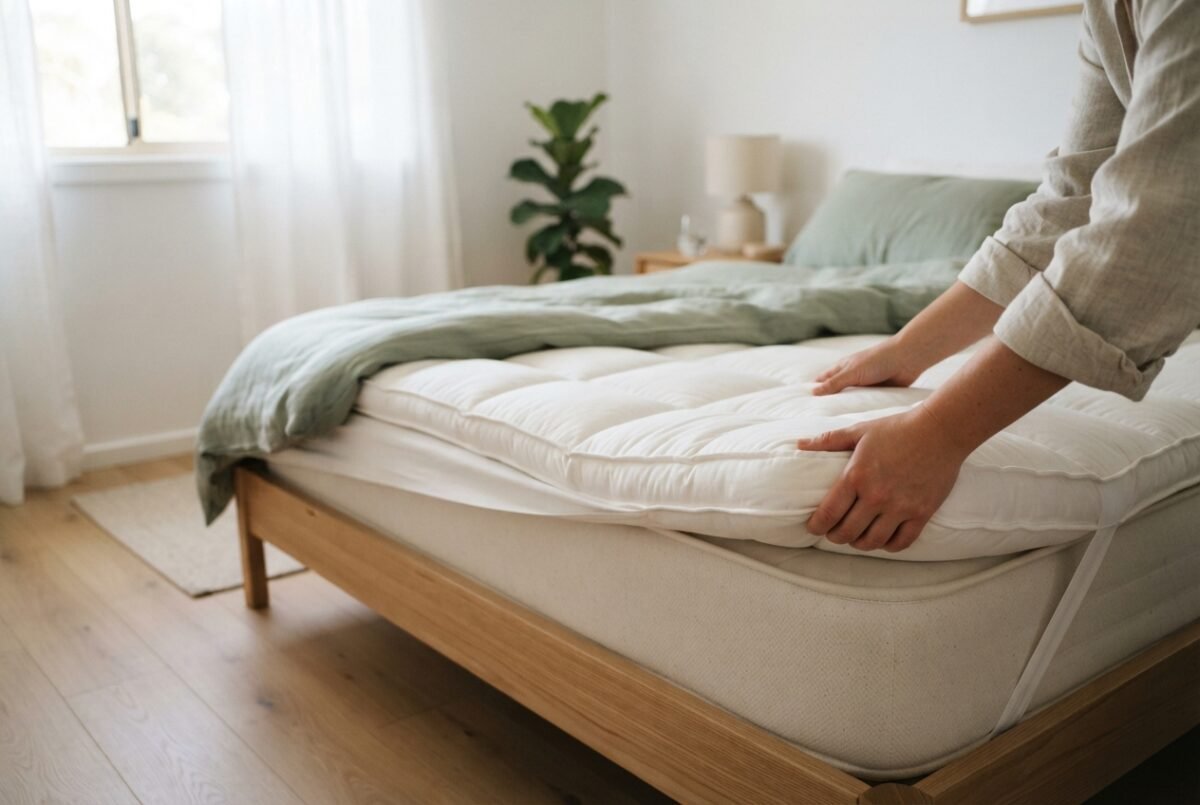
A topper is a thicker layer made to change feel. CHOICE lists wool, memory foam, latex, feather or down and polyester types, and says a topper can smooth out minor dents for a while. It cannot revive a very worn mattress, so see how long a mattress lasts before you spend on one.
If you want a firmer or softer bed, our guides on making a mattress softer and making it firmer cover the options. A protector is a third product, covered in mattress topper vs protector.
Using either with an electric blanket
Many people reach for an underlay in winter, and some also use an electric blanket. Safety advice here comes from fire services. The Metropolitan Fire Service in South Australia says not to leave a blanket on overnight, never to fold it and never to tuck it under the mattress.
Follow the electric blanket maker’s instructions on layering. CHOICE says some models cannot be used on foam mattresses or under protectors, so a thick topper or protector may not be allowed with yours.
Which should you choose?
| If you | Consider |
|---|---|
| Want a slightly softer feel | A topper |
| Want a warmer bed in winter | A thin underlay |
| Have a dust mite allergy | A resistant cover, not wool |
| Have a worn, sagging mattress | A new mattress |
| Want to protect against spills | A protector |
In short, a topper changes the bed and an underlay mostly changes the temperature. Our about page explains how we check sources.
Frequently asked questions
Is an underlay the same as a mattress topper?
No. An underlay is thin and flat, while a topper is a thicker comfort layer of about 2 to 10 cm that changes how the bed feels.
Is a mattress pad the same as an underlay?
Often yes. Mattress pad is a US term, and CHOICE describes pads as pretty much flat, which is how most underlays are sold here.
Does an underlay make a bed softer?
Only a little. A thin layer adds some padding, but a topper has far more effect on firmness.
Can I use a topper with an electric blanket?
Only if the blanket maker allows it. CHOICE says compatibility depends on the topper material, so check the manual.
Is a wool underlay good for allergies?
Usually not. ASCIA advises removing woollen underlays from the bed of someone with a dust mite allergy.