
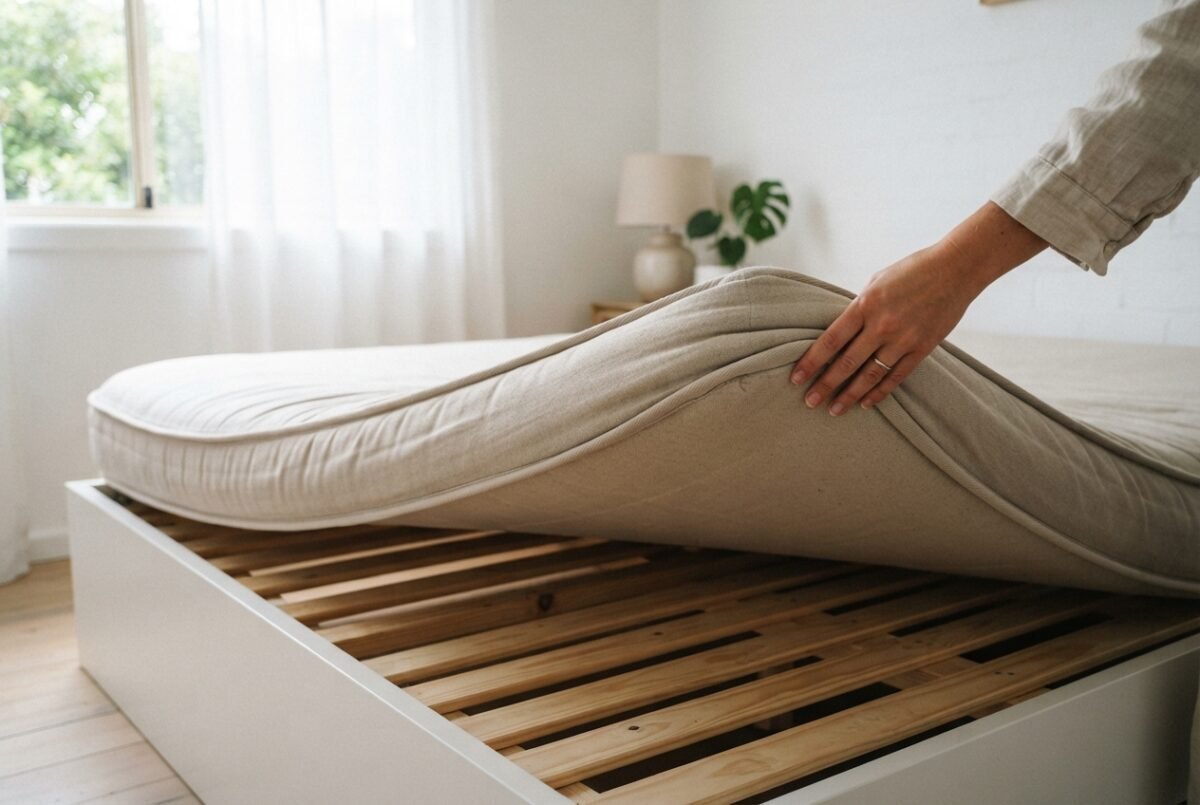
What goes under a mattress? A bed base: a slatted frame, a solid platform or the matching ensemble base. Under that, the legs and a gap of open floor let air move. CHOICE advises against putting a mattress straight on the floor, because very little ventilation means sweat and moisture can build up and raise the risk of mould.
The base matters more than most people expect, because it changes how a mattress feels and how long it stays fresh. This guide covers the common bases, the floor question and what to check before you buy one. It sits in our Mattress Guides.
What goes under a mattress?
Most mattresses sit on one of three supports. Which one suits yours is set by the maker, so check the care label or warranty before you choose.
| Support | What it is | Watch for |
|---|---|---|
| Slatted base | Timber or metal slats on a frame | Slat gaps are set by the maker |
| Solid platform | A flat panel under the mattress | Check the maker allows it |
| Ensemble base | A base sold to match the mattress | Feel changes if you swap it |
| Floor | No base at all | Poor airflow, see below |
CHOICE points out that a fixed slat or hard surface can make a soft mattress feel very different from the ensemble base it sat on in the shop. It suggests trying a mattress on a base similar to the one you have at home.
We found no independent Australian source giving a slat spacing. Treat the figure in the maker’s instructions as the one that counts, since it can also affect the warranty.
Can a mattress go on the floor?
It can, but it isn’t ideal. CHOICE says a mattress on the floor has very little ventilation, so hair, skin and sweat can’t dry away and build up over time. It lists a higher risk of mould, creepy crawlies and possibly bacteria, depending on the environment, and says this can damage the mattress.
The principle is general. NSW Health notes that mould grows indoors where there is moisture and poor ventilation. In humid parts of Queensland, coastal NSW and the Northern Territory, we’d be especially careful about a mattress with no air underneath.
If you must use the floor, CHOICE suggests lifting the mattress regularly and vacuuming underneath. Foam needs extra care, because CHOICE says foam has limited air circulation and absorbs more sweat and fluids.
What about storing things under the bed?
We found no independent guidance on this, so this is our reading. Boxes packed tight to the base reduce the air that reaches it, in the same way a floor does. If you use the space, leave gaps and avoid anything damp, such as clothes that haven’t dried.
Check the base before you buy
A new mattress on an old, sagging or mismatched base can feel wrong or wear faster. If the base is the problem, a new mattress won’t fix it. Once the base is ruled out, see how often to change a mattress. A base that lets the mattress slide is a different issue, covered in our guide to stopping a mattress from sliding.
For the wider decision, start with how to choose a mattress. Our about page explains how we check sources.
If the issue is depth rather than support, see how to make a mattress higher and underlay vs mattress topper.
Frequently asked questions
What goes on a mattress first?
A mattress protector goes on first, then a fitted sheet. CHOICE says a protector keeps body grime off and is easier to clean than the mattress.
What goes over a mattress?
Usually a protector, fitted sheet, then the top sheet and quilt or doona. A topper sits between the protector and the sheet if you use one.
Can I put a mattress directly on the ground?
You can, but CHOICE advises against it because ventilation is very poor. Moisture and sweat can build up, raising the risk of mould.
Does the bed base change how a mattress feels?
Yes. CHOICE says a fixed slat or hard surface can make a soft mattress feel very different from an ensemble base.
Do I need a bed base at all?
Most mattresses need some support and airflow underneath. The maker’s instructions say which bases are allowed.